Case Study · ViCAFE, Switzerland
How ViCAFE Turned One Locations Page into 19 Self-Updating Espresso Bar Pages by Syncing Google Data Through Shopify's Admin API
Region pages, a map, and opening hours synced from Google Maps.
Founded in 2014, ViCAFE is a Swiss specialty coffee roaster with 19 espresso bars across Zurich, Basel, Lausanne, and Eglisau. The brand is defined by the quality of its coffee, ethically sourced and roasted in Zurich, and by a high level of customer service.
Since migrating their online store to Shopify Plus in 2024, ViCAFE has experienced continuous growth. The espresso bars remain the largest part of the business, which makes the locations page one of the most important pages on the site. But the locations page struggled to keep up with ViCAFE's growth. Every espresso bar sat on a single page, grouped by city but with no search or map functionality.
Opening hours lived on Google Maps, where bar managers updated them, and every change had to be reported to ecommerce management and typed into Shopify by hand. The expansion to Lausanne added another region and French language support, which pushed the existing setup to its limit.
ViCAFE had originally chosen roasters.dev, a Shopify Plus partner, for its work with other specialty coffee brands. roasters.dev had managed the 2024 migration, so the two teams already had a history of productive collaboration.
Since partnering with roasters.dev to rebuild its locations pages, ViCAFE has achieved:
- 19 individual espresso bar pages whose opening hours refresh automatically every night
- 31% more users on the location pages in August and September 2026 than in June and July
- 20% more location-related search terms ranking on 30 September 2026 than on 30 June
The Challenge: Nineteen Espresso Bars on One Page, Updated by Hand
For a company whose business happens at the counter, the locations page did real work. It drew a significant share of site traffic from people who wanted to know two things: where the nearest ViCAFE was and whether it was open right now. The page answered neither question well. All espresso bars appeared in one long grid of photos, with each bar's hours hidden behind a hover state.
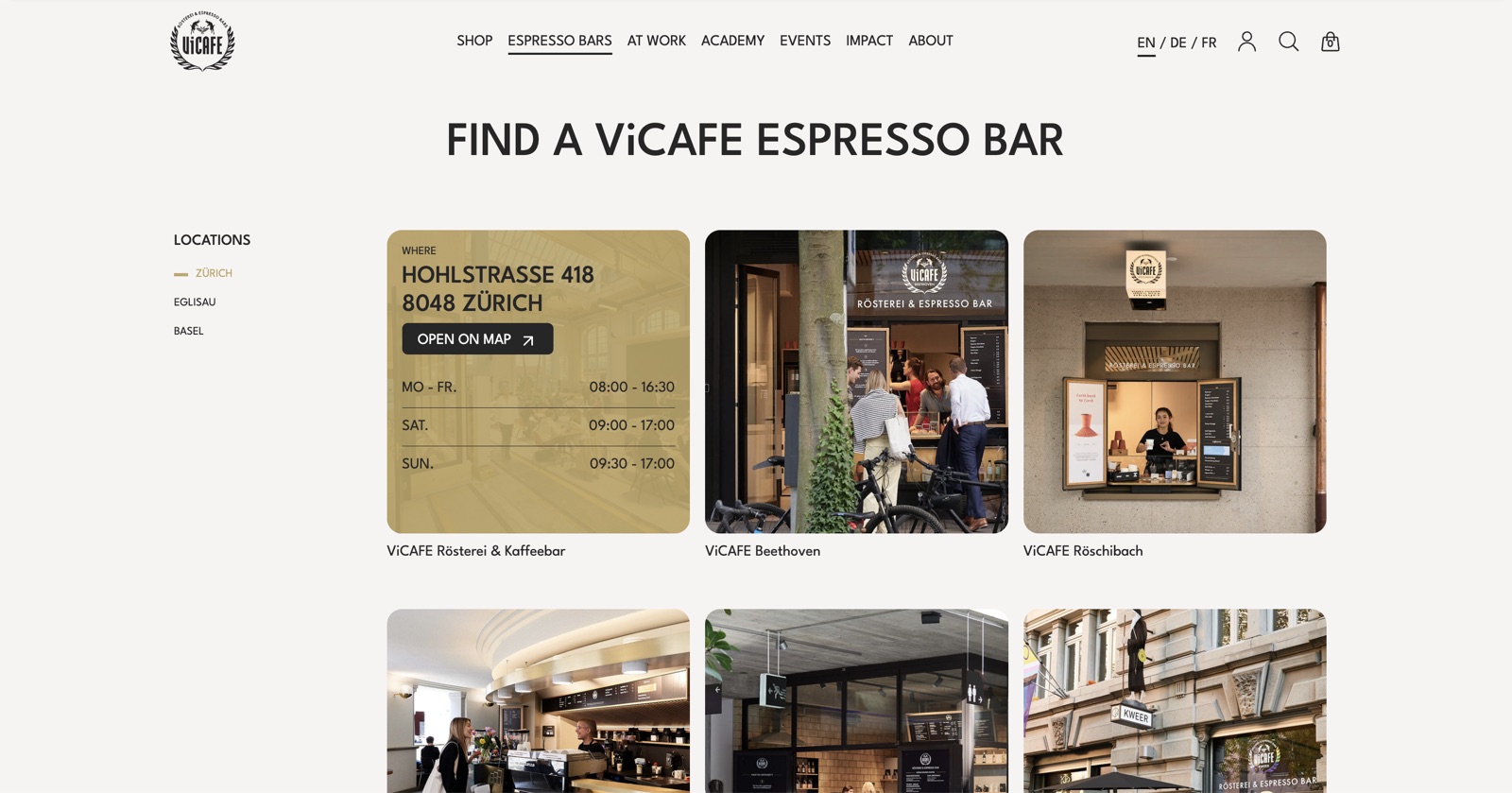
The lack of differentiation also carried a search cost: a single page competing for every city and neighborhood query ranks well for none of them. The page gave search engines and AI assistants little structured information to surface when someone asked for specialty coffee nearby.
Behind the scenes, keeping the page accurate was a chore. Espresso bar managers do not have access to Shopify. When hours changed for a public holiday or the summer season, managers updated them on Google Maps, as they always had, and someone at head office then had to edit the locations page by hand. In practice the website lagged behind Google Maps, and occasionally behind reality. A customer who checked vicafe.ch before heading out could arrive at a closed door.
Previously we had to manually update Espresso Bar hours on the website, and now it automatically updates when changes are made in Google My Business which saves us some meaningful time.
Growth made the problem urgent. Each new bar added another entry to maintain and another chance for the two sources to drift apart. The expansion to Lausanne added a whole new region, along with the brand's first French-speaking customers.
ViCAFE needed advice on what was possible in terms of structure and synchronization. Over a few rounds of brainstorming with the ViCAFE team, roasters.dev landed on a structure that treats each espresso bar as its own record in Shopify and lets a scheduled script fill in existing information from Google Maps. Because the store already ran on Shopify Plus, the structure could live in metaobjects and the sync could write through the Admin API, with no new system to host or maintain.
The Solution: A Google Maps Integration That Keeps Every Espresso Bar Page Current
roasters.dev and ViCAFE worked out the structure together, iterating on what each page should show and how a visitor moves between them. The single page became three connected layers, each answering a narrower question than the one before it. The new pages went live in June 2026 at vicafe.ch/pages/espresso-bars.
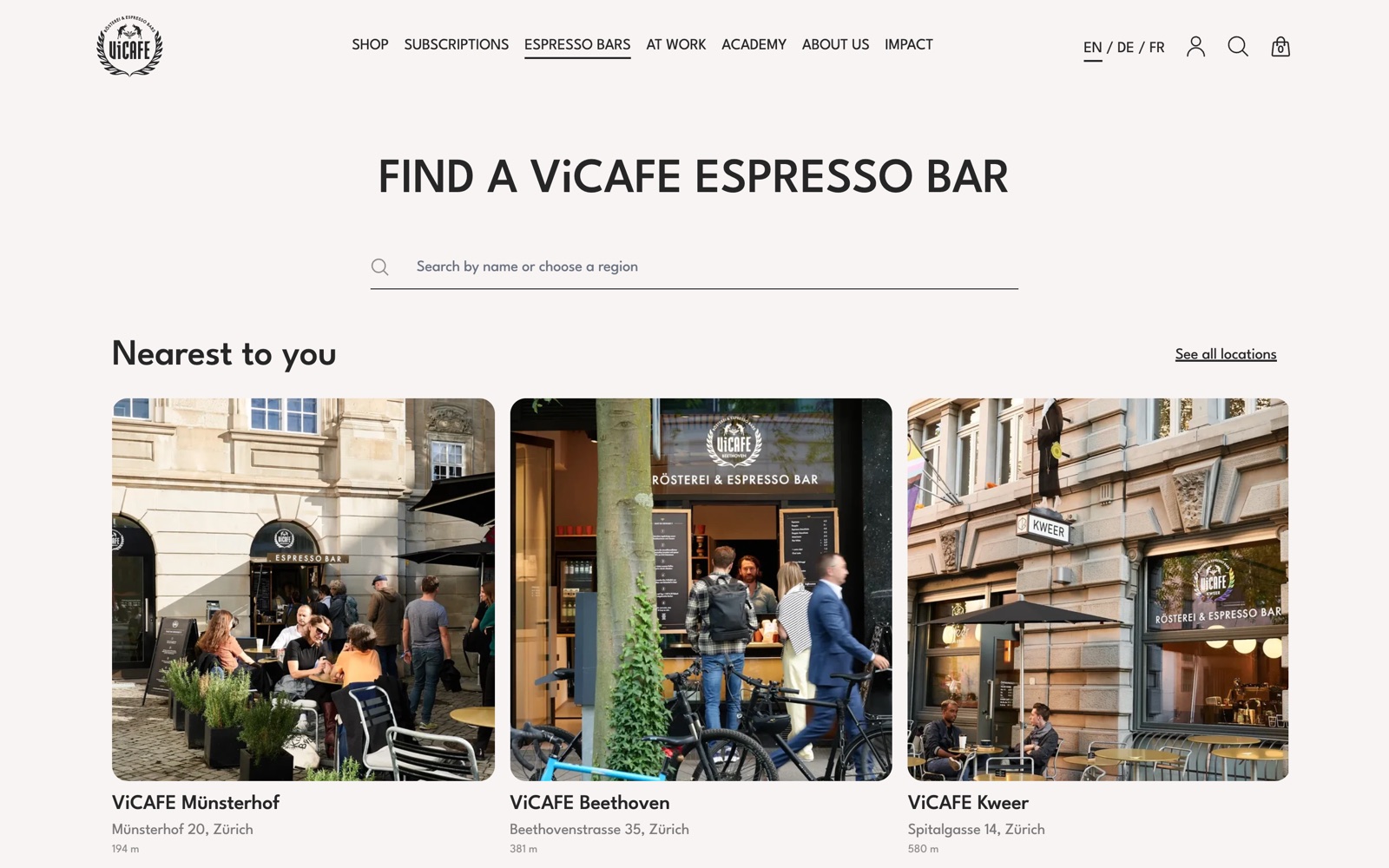
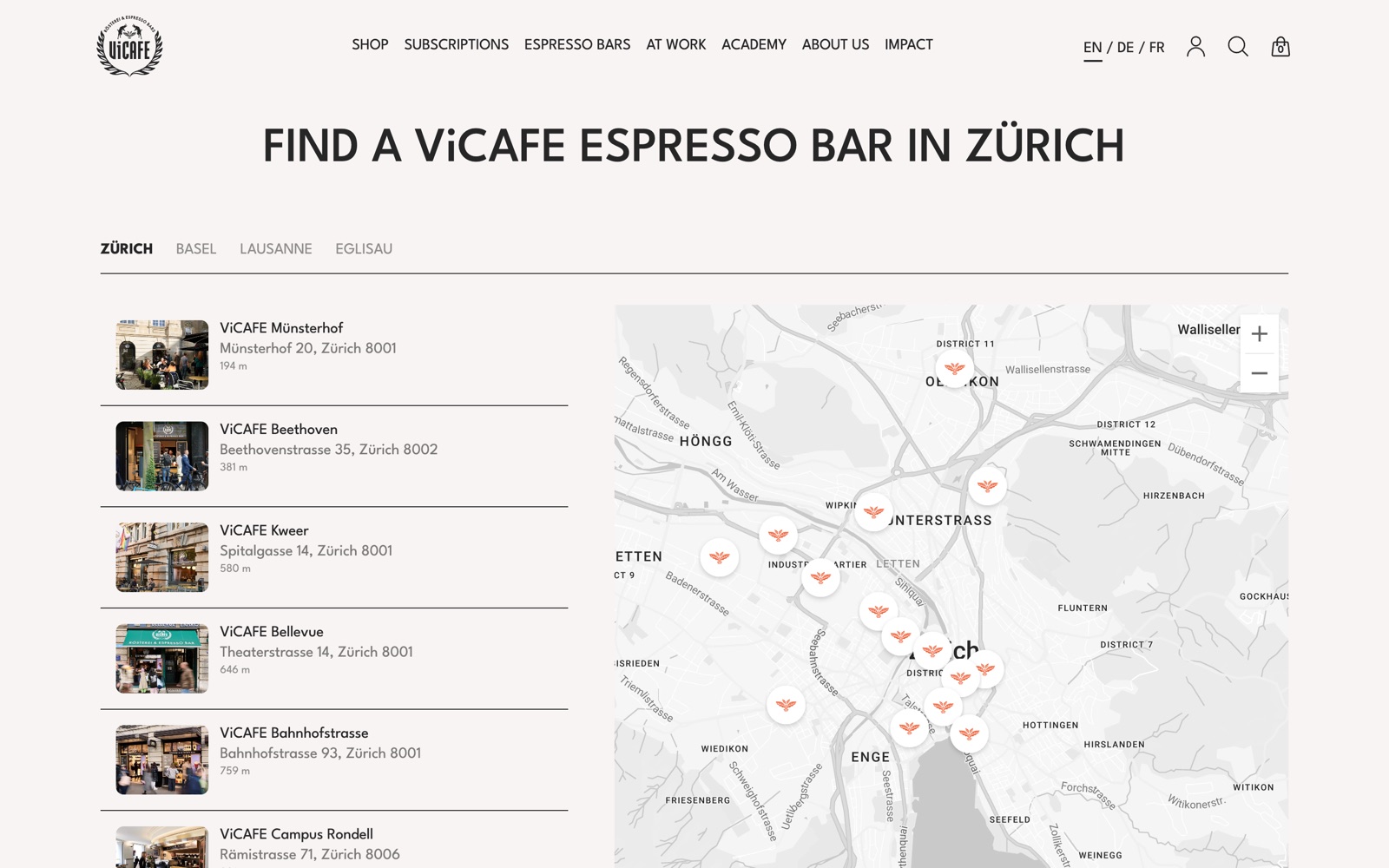
The locations landing page opens with a search box. A visitor types a bar name or picks a region and lands on a matching page, where a styled map with ViCAFE pins sits beside cards sorted by distance. Visitors who share their location see the nearest bars first, with the exact distance on each card.
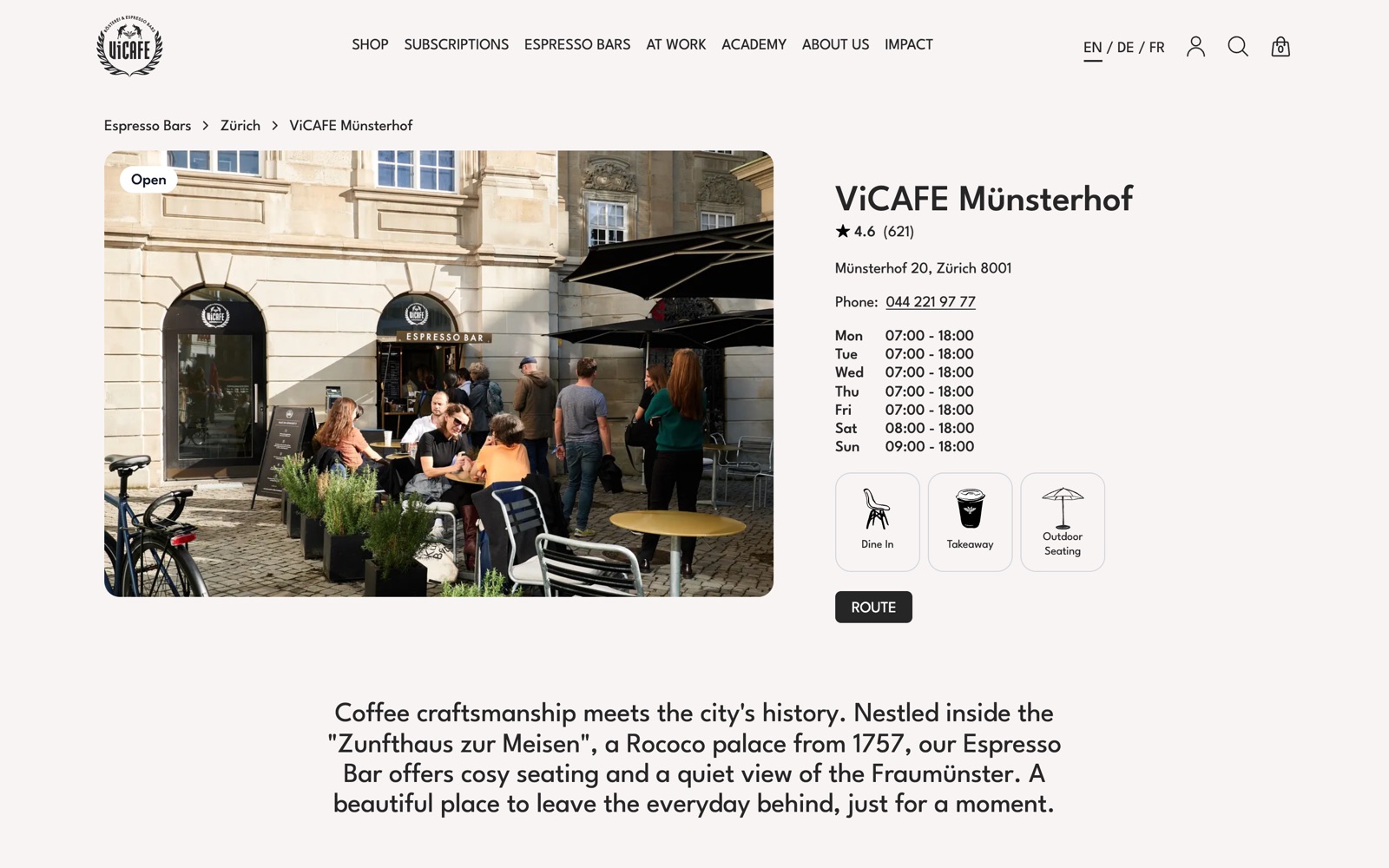
Every espresso bar then has its own page, built to feel like the bar itself: a cover photo, a short description, address, phone, opening hours, payment methods, amenities such as outdoor seating, and links to nearby espresso bars. Connecting to the Google Places API let roasters.dev pull in more than just operating hours. Each page also shows the bar's Google Maps star rating and review count, recent reviews, user-submitted photos, location data, and a list of amenities. Mixing static editorial content with automatically refreshed user-generated content gives ViCAFE well-designed pages that stay fresh without anyone touching the site.
The pages are generated from Shopify metaobjects, one entry per bar. roasters.dev split the fields into two groups and named them so the ViCAFE team can see at a glance which ones they own: manual fields hold the editorial content, automatic fields hold everything that comes from Google. A small sync service on GitHub Actions fills the automatic fields every night.
Bar managers were already keeping Google up to date. The most elegant solution was to sync in the data from there.
Bar managers keep doing exactly what they did before: they update their hours on Google Maps when something changes. The two sources can no longer drift apart, because one now feeds the other.
The structure also serves discovery. Every page exists in English first, with German and French translations, so a customer in Lausanne reads the same current hours in their own language as one in Zurich. Each bar page emits Schema.org structured data from the same fields, so search engines and AI assistants read hours, ratings, and coordinates directly. A query about specialty coffee in Basel now has a specific page to land on, and the answer matches what Google shows.
The Results: Richer Pages, Rising Traffic, and Hours That Are Always Right
In August and September 2026, the location pages drew 31% more users than in June and July. Where one page once absorbed every location query, 19 bar pages and the region pages above them now rank for the city and neighborhood searches that matter to a walk-in business, in English, German, and French. The number of location-related search terms the site ranks for rose by 20% between the end of June and the end of September.
The pages are also more useful once a visitor arrives. Each one carries more information than the old list did, from maps and distances to reviews and hours that match what the bar's own manager entered the day before. Nobody at head office types opening hours into the website anymore, and the error that used to come with that step is gone.
Our old locations page failed to communicate the depth, accuracy and character of each of our Espresso Bars. With the new individual page set up, we are far happier!
Both ViCAFE and roasters.dev are proud of the result. The pages look good, they work reliably, and the project was genuinely fun to work on.
The new setup creates a solid foundation for where ViCAFE is heading. The brand plans to grow in French-speaking Switzerland and in Central Switzerland, and each new bar now needs only a metaobject entry and a Google Place ID to get its own page.
The website now does what the people behind the counter do every day: point visitors to good coffee, close by, with the door open.
The Technical Details
The whole system runs on native Shopify. The only outside pieces are the Google Places API and GitHub Actions for cron scheduling.
Two metaobject definitions, Espresso Bar and Region, have storefront pages enabled and a theme template each under templates/metaobject/. Every bar and every region is a metaobject entry with its own URL in each language. No external CMS and no store locator app are involved.
Fields on the Espresso Bar metaobject carry a manual_ or automatic_ prefix. Manual fields (name, description, cover image, image carousel, payment methods, nearby bars) are edited by the ViCAFE team in the Shopify admin. Automatic fields (business status, weekly schedule including special hours, rating, review count, reviews, photos, postal code, country, coordinates, telephone, Google Maps URL, price range, and amenity flags) are written by the sync and never touched by hand.
The sync is a small Node.js script run by GitHub Actions on a nightly cron. It reads each bar's Google Place ID from Shopify, calls the Google Places API, normalizes the opening periods into a language-neutral schedule object, uploads new photos to Shopify Files, and upserts the automatic fields through the Admin GraphQL API. Every run is a full overwrite, so there is no drift to reconcile. Access goes through a custom app limited to the read_metaobjects, write_metaobjects, and write_files scopes.
The theme renders the pages with Online Store 2.0 sections. Weekday names come from the locale files, so the schedule data stays the same in English, German, and French, and Shopify's Translate & Adapt provides the German and French versions, with region and bar pages routed per language. The landing page geocodes search input with the Google Maps JavaScript API and sorts bars by distance from the visitor. Each bar page emits Schema.org structured data from the same metaobject fields.